










How moving beyond checklists toward contextualized design decisions helps teams avoid rework, misalignment, and downstream design debt.
Product teams are often praised for delivering “on spec.” But here’s the hard truth: checking every box on a requirement document doesn’t guarantee a successful product—or a sustainable architecture.
Too many medical and regulated products meet technical specs and still underperform in the market, fail to integrate with downstream systems, or accumulate unmanageable support burdens. Why? Because the spec didn’t capture the strategic context—the clinical environment, the user journey, the service lifecycle, the evolving regulatory landscape, and the product roadmap beyond MVP.
At Boston Engineering, we see this disconnect regularly. And we help clients solve it by reframing requirements as living, contextualized decisions—not static checklists.

Context Turns Requirements into Resilience
When you design with context, you make smarter decisions earlier. That means fewer change orders, less rework, more reusable architectures, and faster downstream adaptation.
Strategic Contextual Planning is one of our pillars of managing design debt because it accounts for:
- Real users in real environments: Operating room pressure is not the same as bench testing.
- Business model and reimbursement: A feature that delays market access by six months may cost more than it adds.
- Service, support, and compliance: Requirements should be traceable not just to functionality, but to verifiability, manufacturability, and long-term lifecycle cost.
This context isn’t “extra.” It’s the missing link between what gets built and what succeeds.
Signs Your Specs Are Missing Strategic Context
Not sure if you’re heading for trouble? Here are a few red flags:
- Features are defined without understanding how, when, and by whom they’re used
- Verification gets difficult because traceability is murky or incomplete
- Support teams struggle post-launch due to gaps in serviceability planning
- Regulatory submissions raise concerns about “intended use” or performance claims
- Roadmap features require architectural changes instead of simple additions
If you’ve experienced any of these, chances are your spec was technically sufficient—but strategically incomplete.

Documenting What You Aren’t Building Is Just as Critical
Every deferral, shortcut, or simplification should be intentional and visible. That means:
- Capturing non-requirements: What are we explicitly choosing not to build yet, and why?
- Tracking trade-off decisions: What is the estimated cost, risk, and downstream impact of this deferral?
- Ensuring traceability: Can we connect every requirement (and non-requirement) to a rationale that withstands engineering review and regulatory scrutiny?
Without this clarity, design debt creeps in silently. What looks like a well-documented product becomes a liability under change control, a blocker in roadmap expansion, or a pain point for clinicians and service techs in the field.

The Business Case for Contextual Requirements
Designing with context isn’t just smart engineering—it’s good business.
- You reduce mid-lifecycle rework by anticipating integration points and obsolescence paths
- You accelerate verification and submission by grounding features in verifiable claims
- You control support and warranty costs by embedding serviceability and diagnostics from day one
- You gain internal alignment by linking features to stakeholder needs and business goals—not just specs
In our experience, teams that apply strategic context early see dramatically fewer architectural surprises later—and stronger stakeholder trust throughout development.
What This Looks Like in Practice
Imagine your spec calls for a handheld diagnostic device that operates in under 2 seconds and interfaces with a hospital’s EHR. If that spec was written in isolation, the interface might assume plug-and-play compatibility. But if the team embeds contextual understanding, they’ll know:
- The clinical user is wearing gloves and working in low-light conditions
- The hospital has a legacy data format and restricted USB ports
- The device may need future support for cloud uploads or mobile pairing
This insight changes how you design the interface, the data architecture, and the housing—without adding unnecessary features. It makes you launch-ready and roadmap-capable.
Boston Engineering’s Perspective
At Boston Engineering, we don’t just build to spec—we help shape the right spec. Our approach to Strategic Contextual Planning is grounded in:
- Cross-disciplinary interviews and observations
- Trade-off analysis frameworks
- Lifecycle and regulatory planning from the start
- Alignment across product management, engineering, and QA
By baking context into every decision, we help clients reduce design debt before it accrues—ensuring the product that’s built is also the one that succeeds.
-3.png?width=753&height=148&name=Product%20Design%20for%20the%20Future%20(1)-3.png)
Don't ignore the warning signs, let's talk about how to plan for what comes next.
👉 Contact Us to Talk to Our Engineering Strategy Team →
👉 Explore Our Design for X Capabilities →
👉 Learn About Our Product Development Process →
-1.png?width=760&height=95&name=Untitled%20design%20(7)-1.png)
New Design Debt Guide Available Now!
A Strategic Approach to Product Development
-Navigate Trade-offs Without Sacrificing the Future-
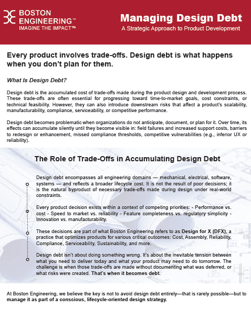 When addressed early and intentionally, design debt becomes a strategic tool, not a liability.
Design debt is the accumulated cost of trade-offs made during the product design and development process. Boston Engineering applies a rigorous, systems-level methodology grounded in DFX and contextual awareness to help clients recognize and mitigate the downstream costs of design decisions.

Download the Latest Immersive Technology Whitepaper from Boston Engineering

Augmented Reality (AR) is revolutionizing the way we interact with digital content, merging the physical and digital worlds in innovative ways. In this white paper, we provide a comprehensive overview of AR, exploring its definition, potential uses, challenges in adoption, and strategies for companies to embrace this transformative technology.
Download to begin Embracing the Future
Ready to learn more about Boston Engineering?
For three decades, Boston Engineering has designed, developed, and optimized devices and technologies the medical community relies on to save lives, enrich quality of life, and reduce costs to the healthcare system. We provide solutions to the challenges in the adoption of surgical robotics.
Our expertise includes industrial design and product redesign, sensors and control systems, robotics technical innovation, and digital software solutions.
Imagine your Impact: Stay up-to-date with the latest insights and trends we're watching. Add your email address below and sign up for a monthly summary of our most impactful posts!
