










Why minimum viable products should be designed for scale, not just for demo.
The MVP Trap: It Works, But It Can’t Grow
You built a prototype. It functions. It proves the concept. It demoed well. But now you’re staring down the next phase—clinical use, regulatory submission, scale-up—and the foundation is crumbling under the weight of what’s next.
Welcome to the brittle MVP. It’s a functional model that wasn’t built with flexibility, compliance, or lifecycle needs in mind. And now, what started as momentum turns into a maze of rework, re-architecture, and re-verification.
At Boston Engineering, we call this one of the earliest signs of design debt—cost, risk, and delay caused by design choices that weren’t planned for evolution.

The Problem Isn’t the MVP. It’s the Assumption You’ll “Fix It Later”
There’s nothing wrong with building a lean prototype to test a hypothesis. In fact, MVPs are essential to good product development. The problem arises when:
- The MVP becomes the foundation for production without re-architecture
- Core trade-offs made during MVP development are undocumented
- The system is designed only for the current use case—not what’s coming next
This is how a single-purpose prototype becomes an obstacle to scale. You realize too late that your electronics can’t be modularized. Your firmware doesn’t allow feature toggles. Your UI is hard-coded to workflows that no longer make sense. You’re shipping quick decisions as permanent infrastructure.
Design Debt Accrues Faster in MVP-First Projects
To avoid this pitfall, we embed Quantified Trade-Off Analysis into our product development process. That means helping clients:
- Maintain a trade-off log that records every deferred or compromised decision
- Estimate the "interest" cost of deferrals (rework, support, risk, lost opportunity)
- Link decisions to specific lifecycle areas: verification, compliance, sourcing, serviceability
- Use scenario modeling to assess “what if” paths across design, cost, and schedule
By turning assumptions into numbers, you gain clarity. You don’t just say, “We’ll worry about that later.” You say, “We’ve deferred this, we know the cost, and we’ve planned for it.”
MVP ≠ Disposable. Build the Right Backbone Early
A better mindset: think of your MVP as a testbed on a future-ready platform. Even if only 10% of the design is “final,” that 10% should be:
- Modular and traceable
- Designed for manufacturability (DfM) and compliance
- Flexible enough to evolve with roadmap needs
- Architected to support risk management and diagnostics
This is what we mean by “right-building the core.” It’s not about over-designing. It’s about making sure the parts that will persist can support what’s coming.

A Better MVP Approach: Document, Design, Defer (Deliberately)
At Boston Engineering, our best-performing MVP programs use a three-step discipline:
- Document What You’re Not Doing
Capture non-requirements clearly: what features, testing, or components are out of scope for now—but expected later. - Design What You Are Doing for Reuse
Ensure architecture decisions can scale—e.g., interfaces that won’t break with feature additions, modular subassemblies, software hooks for future updates. - Defer With Intention
Track deferrals in a trade-off log, assess risk, and revisit them on a regular cadence—so the team stays aligned on what’s coming and why it was deferred.
This approach prevents surprises and empowers teams to evolve MVPs without getting stuck in brittle, short-sighted designs.
Boston Engineering’s Perspective
We've worked on everything from concept prototypes to scaled clinical devices. What we've learned is simple: design debt begins when you treat MVPs like dead ends.
But when you build with context, document trade-offs, and design for change, your MVP becomes an asset—not a liability.
We support teams by:
- Facilitating design trade-off and non-requirement capture from day one
- Building lifecycle-ready architectures even in early prototypes
- Embedding cross-functional DFX reviews to spot downstream risk
- Supporting sustaining engineering to evolve designs over time
It’s not about perfection—it’s about preparation. Your MVP can move fast and set the stage for long-term resilience. With the right partner, you don’t have to choose between speed and strategy.
-3.png?width=753&height=148&name=Product%20Design%20for%20the%20Future%20(1)-3.png)
Don't ignore the warning signs, let's talk about how to plan for what comes next.
👉 Contact Us to Talk to Our Engineering Strategy Team →
👉 Explore Our Design for X Capabilities →
👉 Learn About Our Product Development Process →
-1.png?width=760&height=95&name=Untitled%20design%20(7)-1.png)
New Design Debt Guide Available Now!
A Strategic Approach to Product Development
-Navigate Trade-offs Without Sacrificing the Future-
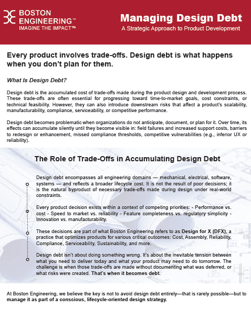 When addressed early and intentionally, design debt becomes a strategic tool, not a liability.
Design debt is the accumulated cost of trade-offs made during the product design and development process. Boston Engineering applies a rigorous, systems-level methodology grounded in DFX and contextual awareness to help clients recognize and mitigate the downstream costs of design decisions.

Download the Latest Immersive Technology Whitepaper from Boston Engineering

Augmented Reality (AR) is revolutionizing the way we interact with digital content, merging the physical and digital worlds in innovative ways. In this white paper, we provide a comprehensive overview of AR, exploring its definition, potential uses, challenges in adoption, and strategies for companies to embrace this transformative technology.
Download to begin Embracing the Future
Ready to learn more about Boston Engineering?
For three decades, Boston Engineering has designed, developed, and optimized devices and technologies the medical community relies on to save lives, enrich quality of life, and reduce costs to the healthcare system. We provide solutions to the challenges in the adoption of surgical robotics.
Our expertise includes industrial design and product redesign, sensors and control systems, robotics technical innovation, and digital software solutions.
Imagine your Impact: Stay up-to-date with the latest insights and trends we're watching. Add your email address below and sign up for a monthly summary of our most impactful posts!
