










When engineers spend more time reacting to failures than building the future, it’s time to reassess the system, not the team.
In many medical device companies, the engineering team becomes the de facto fire department. They’re constantly pulled into root cause investigations, supplier escalations, design fixes, documentation patches, and field issue analysis. They’re good at it—exceptionally so—but they’re also stuck.
The result? Product evolution slows, morale dips, and strategy takes a back seat to survival.
But this isn’t a performance issue. It’s a symptom of unmanaged design debt—and a lack of systems that support sustainable innovation.

From Product Development to Post-Launch Purgatory
Your engineers were hired to solve complex problems, design next-gen features, and push the envelope of innovation. But in many organizations, they’re tied up chasing problems from the past. Why?
Because trade-offs made during development—rushed interfaces, incomplete verification, monolithic architectures, or under-documented changes—create hidden liabilities. When those liabilities surface post-launch, the burden lands on engineering to “make it right.”
Without clear lines between sustaining engineering, platform evolution, and new product development, your team becomes a perpetual triage unit.

Design Debt Puts Strategy at Risk
When engineering is in reactive mode:
- Product roadmaps stall or shrink
- Long-term architecture suffers from incremental patchwork
- Institutional knowledge gets burned out or lost
- Regulatory and quality risks grow under the radar
- The team’s creativity is drained by urgency, not driven by vision
In this environment, even simple updates—like adding interoperability, expanding market fit, or swapping an EOL component—can trigger delays, re-verification, and full system rework.
The result? Your product loses ground in the market while your team loses faith in the system.
Engineering Deserves to Be Strategic
Your engineering team isn’t the problem—they’re the untapped solution. But to thrive, they need to operate in an environment that supports forward momentum:
- A documented, cross-functional design debt management process
- Proactive architecture designed for adaptability and serviceability
- Clear boundaries between support, sustaining, and strategic functions
- Tools for traceability, diagnostics, and root cause analysis
- Leadership support for roadmap-aligned priorities—not just hotfixes
When these structures are in place, engineering moves from “just keeping up” to driving product innovation and lifecycle resilience.

Boston Engineering’s Perspective
At Boston Engineering, we see engineering as the heartbeat of a product’s evolution—not its cleanup crew.
We help companies:
- Identify and quantify existing design debt
- Build processes for managing resolution and recovery
- Separate sustaining engineering from new development workflows
- Re-architect platforms for easier adaptation, not constant rework
- Support engineering leaders in reclaiming their roadmap
When your engineers are free to lead instead of chase problems, they bring more than fixes—they bring vision, velocity, and real innovation.

You’ve seen the symptoms. Now’s the time to build the system. Let’s turn your product pain points into a platform for progress.
👉 Contact Us to Talk to Our Engineering Strategy Team →
👉 Explore Our Design for X Capabilities →
👉 Learn About Our Product Development Process →
-1.png?width=760&height=95&name=Untitled%20design%20(7)-1.png)
New Design Debt Guide Available Now!
A Strategic Approach to Product Development
-Navigate Trade-offs Without Sacrificing the Future-
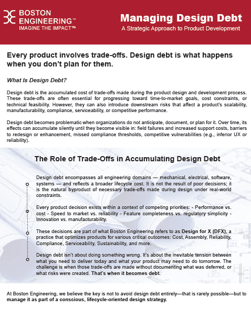 When addressed early and intentionally, design debt becomes a strategic tool, not a liability.
Design debt is the accumulated cost of trade-offs made during the product design and development process. Boston Engineering applies a rigorous, systems-level methodology grounded in DFX and contextual awareness to help clients recognize and mitigate the downstream costs of design decisions.

Download the Latest Immersive Technology Whitepaper from Boston Engineering

Augmented Reality (AR) is revolutionizing the way we interact with digital content, merging the physical and digital worlds in innovative ways. In this white paper, we provide a comprehensive overview of AR, exploring its definition, potential uses, challenges in adoption, and strategies for companies to embrace this transformative technology.
Download to begin Embracing the Future
Ready to learn more about Boston Engineering?
For three decades, Boston Engineering has designed, developed, and optimized devices and technologies the medical community relies on to save lives, enrich quality of life, and reduce costs to the healthcare system. We provide solutions to the challenges in the adoption of surgical robotics.
Our expertise includes industrial design and product redesign, sensors and control systems, robotics technical innovation, and digital software solutions.
Imagine your Impact: Stay up-to-date with the latest insights and trends we're watching. Add your email address below and sign up for a monthly summary of our most impactful posts!
