










You Can’t Build the Future on a Crumbling Foundation
Designing a next-generation product isn’t just about adding new features—it’s about building on what came before. But if your current platform is burdened by unresolved design debt—technical limitations, undocumented trade-offs, or shortcuts taken under pressure—you’re setting yourself up for cost overruns, time delays, and compromised outcomes.
At Boston Engineering, we’ve seen how unmanaged design debt in earlier generations quietly constrains innovation. And we’ve helped teams break that cycle by confronting it head-on—turning hidden liabilities into launchpads for competitive advantage.
This blog explores how forward-looking organizations plan for their next-gen products by first resolving the debt embedded in today’s systems.

The Real Cost of Inherited Debt
When you begin a new product generation, you’re not starting fresh. You're inheriting the architecture, documentation gaps, and system behaviors of every previous version. Left unchecked, this legacy debt quietly metastasizes into:
- Rigid architectures that resist change
- Support systems overloaded with workarounds
- Verification and validation challenges
- Regulatory gaps and slowed submissions
- Integration headaches across modules and interfaces
One team we worked with came to us expecting help designing a new interface module. What they actually needed was a root cause analysis of hidden interoperability assumptions embedded in the original platform. By tracing that lineage and restructuring their interfaces, we helped them unlock not just this module—but an entire future roadmap.

Debt is Inevitable—But It Doesn’t Have to Be Invisible
Design debt often starts as an intentional trade-off: skipping diagnostic hooks, choosing a single-source component, or deferring formal traceability in favor of speed. These choices aren’t inherently bad. But when they’re undocumented, unquantified, or unacknowledged—they become liabilities.
To future-proof effectively, teams must:
- Conduct structured design debt inventories
- Identify architectural “pinch points” for scalability
- Reassess deferred requirements from previous releases
- Review sustaining engineering logs for recurring failures or hacks
- Engage manufacturing, service, and compliance teams to surface hidden friction
This doesn’t just apply to legacy hardware. In medtech and regulated systems, software updates or new workflows often depend on platform-level decisions made years ago. The only way to avoid being surprised by them is to trace—and plan for—them now.
Build Your Next Gen with Debt in Mind
A next-gen product is your chance to get it right—not just to wow users, but to create a foundation for long-term adaptability, compliance, and sustainability. That means treating design debt not as something to outrun, but as something to strategically manage before you build again.
A roadmap for doing this might include:
- Strategic Contextual Planning: Understand not just what’s changing, but what you’re carrying forward—and why.
- Lifecycle-Ready Architecture: Plan for growth with modularity, testability, and service access built in.
- Quantified Trade-Offs: Align stakeholders on what’s deferred, what’s changed, and what it will cost to delay again.
- Cross-Functional Alignment: Bake in DFX principles from the start to ensure manufacturability, serviceability, and cost control.
- Debt Resolution Planning: Identify what needs to be paid down before you can scale and how.

Boston Engineering’s Perspective
At Boston Engineering, we view every next-gen product initiative as both an opportunity and a risk. It’s a chance to evolve your value proposition, but also a moment when accumulated debt can stall or sabotage progress. That’s why we bring together architecture reviews, DFX analysis, sustaining engineering insights, and systems thinking to create a recovery-to-readiness path.
We help future-proof platforms. Whether it’s through trade-off facilitation, root cause analysis, modular architecture development, or cross-disciplinary roadmapping, our job is to make sure your next generation doesn’t repeat, or amplify, the compromises of the last.
Because innovation should move forward—not drag the past with it.

Let’s design with clarity. Let’s build with resilience.
👉 Contact Us to Talk to Our Engineering Strategy Team →
👉 Explore Our Design for X Capabilities →
👉 Learn About Our Product Development Process →
-1.png?width=760&height=95&name=Untitled%20design%20(7)-1.png)
New Design Debt Guide Available Now!
A Strategic Approach to Product Development
-Navigate Trade-offs Without Sacrificing the Future-
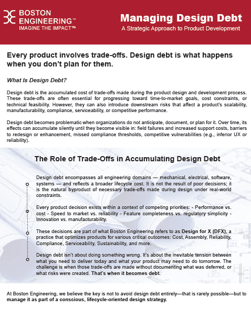 When addressed early and intentionally, design debt becomes a strategic tool, not a liability.
Design debt is the accumulated cost of trade-offs made during the product design and development process. Boston Engineering applies a rigorous, systems-level methodology grounded in DFX and contextual awareness to help clients recognize and mitigate the downstream costs of design decisions.

Download the Latest Immersive Technology Whitepaper from Boston Engineering

Augmented Reality (AR) is revolutionizing the way we interact with digital content, merging the physical and digital worlds in innovative ways. In this white paper, we provide a comprehensive overview of AR, exploring its definition, potential uses, challenges in adoption, and strategies for companies to embrace this transformative technology.
Download to begin Embracing the Future
Ready to learn more about Boston Engineering?
For three decades, Boston Engineering has designed, developed, and optimized devices and technologies the medical community relies on to save lives, enrich quality of life, and reduce costs to the healthcare system. We provide solutions to the challenges in the adoption of surgical robotics.
Our expertise includes industrial design and product redesign, sensors and control systems, robotics technical innovation, and digital software solutions.
Imagine your Impact: Stay up-to-date with the latest insights and trends we're watching. Add your email address below and sign up for a monthly summary of our most impactful posts!
