










The Hidden Cost Lurking in Every Product
In product development—especially in regulated, high-stakes markets like medical devices, defense, and industrial automation—every decision made on Day One carries a ripple effect. Under pressure to move fast, teams make trade-offs to hit milestones, lock in MVP features, or meet budget targets. These choices may feel right in the moment—but without a deliberate, documented strategy, they often come back to haunt you. This is design debt.
Design debt is the downstream cost and risk created by early design decisions that sacrifice flexibility, documentation, or architecture integrity for short-term gains. It’s the bug that slips through because verification was trimmed. The field failure caused by an obscure supplier dependency. The platform re-architecture required because your MVP wasn’t modular. And like financial debt, design debt accrues interest in the form of rework, compliance risk, and lost competitive advantage.
But here's the good news: design debt is a reality, not a flaw. And when managed proactively, it can be a tool instead of a liability.
This post explains why planning for design debt on Day One is essential, how Boston Engineering helps organizations do exactly that. Discover what happens when you work with a partner that treats trade-offs not as accidents, but as assets to track, quantify, and manage across the lifecycle.

What Is Design Debt, Really?
Design debt is often confused with technical debt—but the two aren’t the same. Technical debt is typically limited to software shortcuts. Design debt applies to the entire system—hardware, firmware, UI/UX, verification, documentation, supply chain, serviceability, and compliance readiness.
In other words: where technical debt ends, design debt begins.
Design debt stems from real-world constraints: limited resources, evolving requirements, ambiguous specs, and aggressive timelines. But unmanaged, it becomes the reason:
- Regulatory submissions stall due to missing traceability
- Field diagnostics are costly due to poor architecture
- Version 2.0 requires re-architecture because 1.0 wasn’t modular
- Integration with new ecosystems (e.g., hospital data systems) becomes expensive or impossible
Recognizing design debt early—and documenting it with intent—turns it from a risk into a manageable variable.
Why It Starts on Day One

The single biggest misconception in product development? That you can “avoid” design debt by building the perfect product the first time.
In reality, no team has perfect foresight—and attempting to “boil the ocean” early on leads to scope creep, paralysis, or burnout.
That’s why mature product development firms like Boston Engineering don’t pretend to eliminate design debt. We help our clients plan for it strategically. We begin by identifying what’s essential now, what’s being deferred, and what the lifecycle impact of each decision will be—before those decisions are made.
This requires both a process framework and the cross-disciplinary expertise to apply it. That’s where our Design for X (DFX) foundation comes in.
DFX: The Lens That Sees Downstream
Boston Engineering incorporates DFX—Design for Manufacturability, Design for Reliability, Design for Serviceability, Design for Cost, Design for Compliance, and Design for Sustainability—from the outset.
Why? Because DFX reveals the true cost of trade-offs.
Let’s say you choose a non-modular design to get to market quickly. A DFX-informed team would flag that choice as a future bottleneck if you need to upgrade sensors or adjust for regional variants. Instead of treating that choice as a blind risk, we document it, log it, and model the potential cost of change. We help you create non-requirements: a clear record of what’s intentionally deferred, and why.
This is how DFX transforms development from a chaotic race into a strategic, lifecycle-informed process.

Roadmapping: Planning for What’s Now—and What’s Next
One of the most powerful tools for managing design debt is a Product Roadmap that includes both functional evolution and technical underpinnings. Boston Engineering helps product teams create actionable roadmaps that integrate:
- Architectural decisions that align with future capabilities
- Deferred features that are acknowledged and traced
- Design rationales that document why choices were made
- Stakeholder alignment across clinical, regulatory, operations, and service teams
By aligning short-term objectives with long-term product strategy, these roadmaps turn unknowns into investment decisions. That means less surprise rework and more predictable development costs.
What Happens Without a Plan?
When design debt isn’t tracked, it becomes a pattern of recurring pain:
- Change orders triggered by undocumented assumptions
- Support burden driven by inaccessible diagnostics
- Missed revenue from integration delays
- Audit findings due to traceability gaps
- Endless rework cycles driven by unclear ownership
These aren’t isolated problems—they’re symptoms of a system without a plan. And by the time you’re feeling the pain, fixing it costs 5x to 10x more than building with foresight from the start.
-3.png?width=753&height=148&name=Product%20Design%20for%20the%20Future%20(1)-3.png)
Why the Right Partner Matters
Many product developers say they “do DFX” or “track trade-offs,” but lack the depth and cross-functional maturity to execute it in practice.
At Boston Engineering, our program managers, engineers, and product strategists don’t just check boxes. They collaborate across disciplines to embed resilience into your product at every phase—from prototype to scale to sustainment.
Our approach includes:
- Trade-off logging and risk modeling to quantify deferred choices
- Architecture scoring to evaluate flexibility and platform health
- Lifecycle planning to anticipate cost of change
- Cross-functional design reviews that integrate service, regulatory, and operations feedback early
This is why we’re often brought in after a product hits a wall—but our real power is starting with you from the beginning.
Final Thought: If You’re Not Managing It, You’re Paying for It
Design debt isn’t a one-time oversight. It’s the cumulative effect of untracked trade-offs—and it begins the moment product development starts.
You can’t avoid every compromise. But you can choose to manage them—with foresight, documentation, and the right partner by your side.
If your product strategy needs to scale, evolve, and stand up to the pressures of real-world use, you need a firm that does more than build—you need one that helps you plan, measure, and manage every decision from Day One.
Let’s talk about building a roadmap that works now—and later.
👉 Contact Us to Talk to Our Engineering Strategy Team →
👉 Explore Our Design for X Capabilities →
👉 Learn About Our Product Development Process →
-1.png?width=760&height=95&name=Untitled%20design%20(7)-1.png)
New Design Debt Guide Available Now!
A Strategic Approach to Product Development
-Navigate Trade-offs Without Sacrificing the Future-
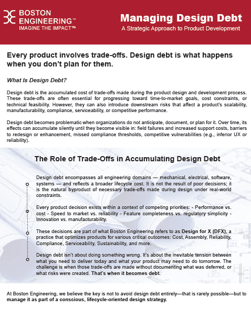 When addressed early and intentionally, design debt becomes a strategic tool, not a liability.
Design debt is the accumulated cost of trade-offs made during the product design and development process. Boston Engineering applies a rigorous, systems-level methodology grounded in DFX and contextual awareness to help clients recognize and mitigate the downstream costs of design decisions.

Download the Latest Immersive Technology Whitepaper from Boston Engineering

Augmented Reality (AR) is revolutionizing the way we interact with digital content, merging the physical and digital worlds in innovative ways. In this white paper, we provide a comprehensive overview of AR, exploring its definition, potential uses, challenges in adoption, and strategies for companies to embrace this transformative technology.
Download to begin Embracing the Future
Ready to learn more about Boston Engineering?
For three decades, Boston Engineering has designed, developed, and optimized devices and technologies the medical community relies on to save lives, enrich quality of life, and reduce costs to the healthcare system. We provide solutions to the challenges in the adoption of surgical robotics.
Our expertise includes industrial design and product redesign, sensors and control systems, robotics technical innovation, and digital software solutions.
Imagine your Impact: Stay up-to-date with the latest insights and trends we're watching. Add your email address below and sign up for a monthly summary of our most impactful posts!
