










Design debt isn’t a bug—it’s a bill. And if you don’t plan to pay it back, it’ll come due on someone else’s schedule.
Whether it’s rushed decisions, deferred features, or documentation gaps, every product accumulates design debt across its lifecycle. And while some teams cross their fingers and hope it won’t matter, the reality is simple: it always surfaces. The difference between teams who succeed and those who struggle isn’t the amount of debt—it’s whether they had a plan to resolve it.
In this post, we explore how strategic planning, smart architecture, and embedded cross-functional foresight can turn design debt from a source of surprise into a managed investment.

When “Later” Finally Arrives
Design decisions made under pressure—limited budget, tight timelines, unclear requirements—often involve deliberate trade-offs. That’s not failure. That’s product development. But what happens when “we’ll fix it later” becomes “it’s failing in the field” or “we can’t scale because of this”?
We see it all the time:
- A hardcoded workflow that worked in the prototype now blocks integration with hospital systems.
- A test rig that only exists in R&D, not production, becomes the bottleneck in scaling.
- A regulatory submission that skipped documentation review now slows change control.
Debt you didn’t plan to resolve becomes firefighting.

Resolution Starts in Architecture, Not Support Tickets
The best time to resolve design debt is before it becomes field failure. The second-best time? Before it derails your next release.
Planning for debt resolution means building it into your development lifecycle:
- Tag deferrals explicitly during early design phases
- Maintain traceability between decisions and testability
- Architect modularity into both hardware and software platforms so known limitations can be isolated and replaced without ripple effects
- Build design history files and verification artifacts as you go—not in a mad rush before a submission
This isn’t extra work. It’s smart work. And it’s what differentiates teams that launch and scale successfully from those stuck in reactive churn.
RCA + Sustaining + Platform Thinking = Resolution Strategy
Resolving design debt isn’t just fixing a bug or replacing a component—it’s understanding the root cause and eliminating the pattern that let it through.
That’s why leading teams invest in:
- Sustaining engineering with direct access to design history
- Root cause analysis (RCA) frameworks that connect field performance to design decisions
- Platform roadmaps that evolve with every issue—not just patch and forget
Done right, this transforms engineering from support mode into strategic enablement. Failures become feedback loops. Revisions become product evolution. And teams start to work with debt, not against it.

Boston Engineering’s Perspective
At Boston Engineering, we don’t just help teams design great products—we help them anticipate, track, and resolve the debt those designs inevitably carry. Our lifecycle-focused approach ensures:
- Trade-offs are captured, not buried
- DFX is embedded from day one
- RCA is mapped to design decisions, not just symptoms
- Sustaining engineering isn’t a Band-Aid—it’s part of the roadmap
Whether you’re starting a new development or in the midst of post-launch firefighting, we bring a process that’s built for resolution—not reaction. Because when debt is visible, managed, and planned for, it becomes a strategic tool—not a liability.
Let’s design with clarity. Let’s build with resilience.
👉 Contact Us to Talk to Our Engineering Strategy Team →
👉 Explore Our Design for X Capabilities →
👉 Learn About Our Product Development Process →
-1.png?width=760&height=95&name=Untitled%20design%20(7)-1.png)
New Design Debt Guide Available Now!
A Strategic Approach to Product Development
-Navigate Trade-offs Without Sacrificing the Future-
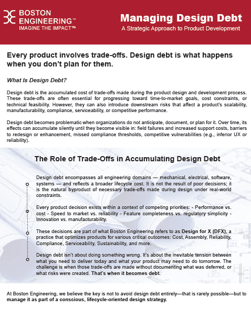 When addressed early and intentionally, design debt becomes a strategic tool, not a liability.
Design debt is the accumulated cost of trade-offs made during the product design and development process. Boston Engineering applies a rigorous, systems-level methodology grounded in DFX and contextual awareness to help clients recognize and mitigate the downstream costs of design decisions.

Download the Latest Immersive Technology Whitepaper from Boston Engineering

Augmented Reality (AR) is revolutionizing the way we interact with digital content, merging the physical and digital worlds in innovative ways. In this white paper, we provide a comprehensive overview of AR, exploring its definition, potential uses, challenges in adoption, and strategies for companies to embrace this transformative technology.
Download to begin Embracing the Future
Ready to learn more about Boston Engineering?
For three decades, Boston Engineering has designed, developed, and optimized devices and technologies the medical community relies on to save lives, enrich quality of life, and reduce costs to the healthcare system. We provide solutions to the challenges in the adoption of surgical robotics.
Our expertise includes industrial design and product redesign, sensors and control systems, robotics technical innovation, and digital software solutions.
Imagine your Impact: Stay up-to-date with the latest insights and trends we're watching. Add your email address below and sign up for a monthly summary of our most impactful posts!
